International Excellence Award: Anne Mackay
Jan 27, 2026; Mathematics Building 20.30 | Room 1.067
Program Details

Motivation for joining MathSEE?
Video Portraits of our Members
Visit one of our research seminars for latest results and updates on applications of mathematical methods
Upcoming and Past Seminars
Get to know KCDS!
More Information"Mathematics in Sciences, Engineering, and Economics"
The KIT Center "MathSEE" (Mathematics in Sciences, Engineering, and Economics) pools the interdisciplinary mathematical research at KIT since October 2018. The Collaborative Research Center 1173 "Wave Phenomena: Analysis and Numerics" and other existing cooperations form the basis for the establishment of MathSEE. Our members from the career level doctoral researcher onwards work together in exchange formats and interdisciplinary research projects structured in Method Areas. MathSEED through its umbrella graduate school offers a comprehensive program for early career researchers and master students to foster interdisciplinary training. Our graduate school KCDS provides structured program for doctoral students in computational and data science. MathSEE offers to strengthen interdisciplinary mathematical research at KIT and its visibility.
The research of the scientists in Nadja's MBD Lab is at the intersection of statistics and machine learning. It spans theoretical analysis, method development and real-world applications.This podcast episode builds up on an earlier one on bayesian statistics including new applications
Details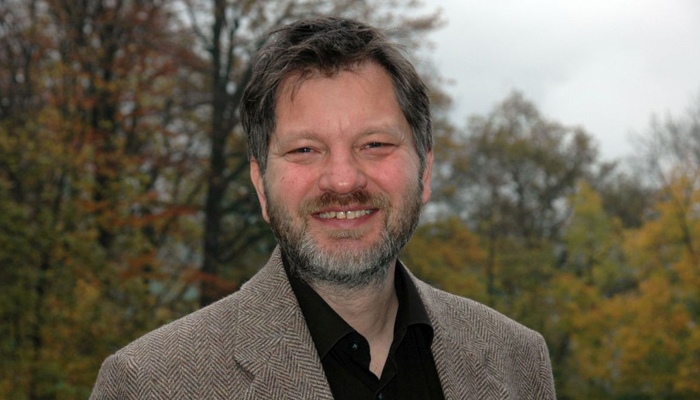
The annual award that honors Abraham Wald is presented to a person whose contributions have been fundamental to the development of statistics or probability . For 2026, Prof. Dr. Tilmann Gneiting received the prestigious Wald memorial award and will deliver the Wald Lecture at the IMS Annual Meeting, July 6-9, 2026 in Salzburg
Press Release
The block course (2-3 days) starting in April 2026 will focus on the importance of good predictions striking a balance between prediction risks and the impact of potentially damaging events with a strong theoretical base. The students get to choose a topic from a range of several research topics, conduct their independent research and submit a thesis at the end of the summer semester to receive 3 ECTS. We highly encourage mathematical students to dive into this course gaining insights into theory and applications of mathematical methods under optimal supervision.
Course Registration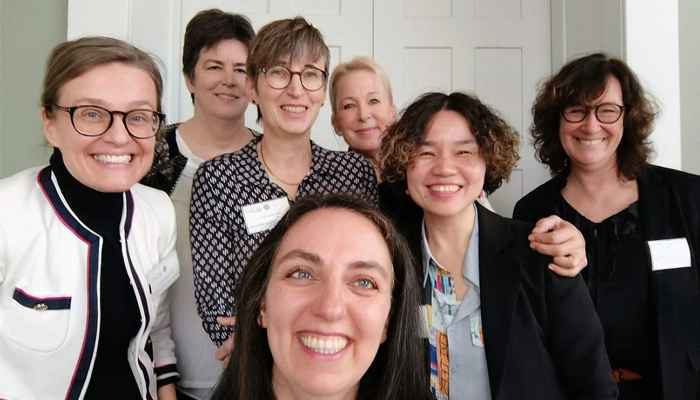
Asset allocation and asset pricing in regulated markets and institutions is one of 7 research units that was awarded funding by the German Research Foundation, on July 2nd, 2025, for the first funding period. With MathSEE steering board member, Prof. Dr. Nicole Bäuerle, as co-speaker of the research unit and Prof. Dr. Melanie Schienle as PI, we are very pleased and honored to make this announcement. The research unit comprises of 6 institutions including University of Ulm, Karlsruhe Institute of Technology, University of Munster, University of Tübingen, University of Duisburg-Essen and University of Paderborn.
More Information
JProf. Manuel Krannich received the coveted ERC Starting Grant for “Manifolds and Functor Calculus” at the Institute for Algebra and Geometry for a period of five years (2026–2031). The research project will be funded with €1.5 million and is another success for interdisciplinary mathematical research at KIT. We warmly congratulate on the great success!
Profile-JProf Manuel Krannich
What role can AI play not only in modernizing the current society and impacting the global future through innovations but also in understanding history, culture and civilizations will be explored at the Berlin Science Week in a panel discussion on November 5th, 2025 with MathSEE member Prof. Nadja Klein.
Berlin Science Week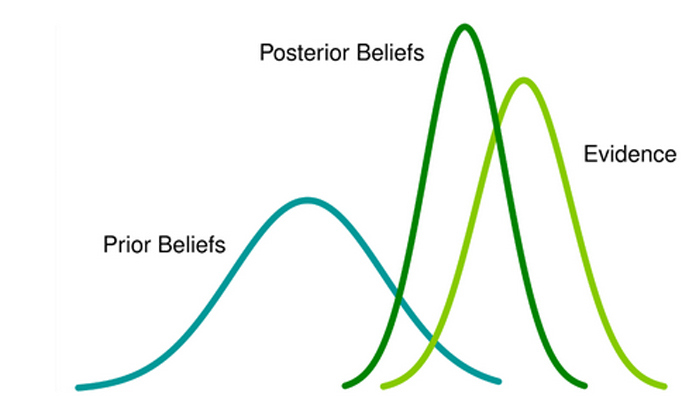
In this project, researchers are developing a general causal foundation model, including high-dimensional, temporal and multimodal data using tolls from representation learning, statistical efficiency theory
and specific ML methods. To enhance efficiency, techniques for efficient learning algorithms specifically tailored to causal machine learning are being investigated, such as synthetic pre-training, transfer learning, and few-shot learning.
Gudrun Thäter talks to Nadja Klein and Moussa Kassem Sbeyti on mathematical method development at the intersection of statistics and machine learning, in particular on Bayesian methods, which allows the incorporation of prior knowledge, quantification of uncertainties bringing insights into the black boxes of machine learning
Modellansatz
With their research on explainable AI, Prof. Nadja Klein and Tim Bündert aim at solving the black box problem of how AI models work and what goes on in the background
KIT Podcast: Campus Report